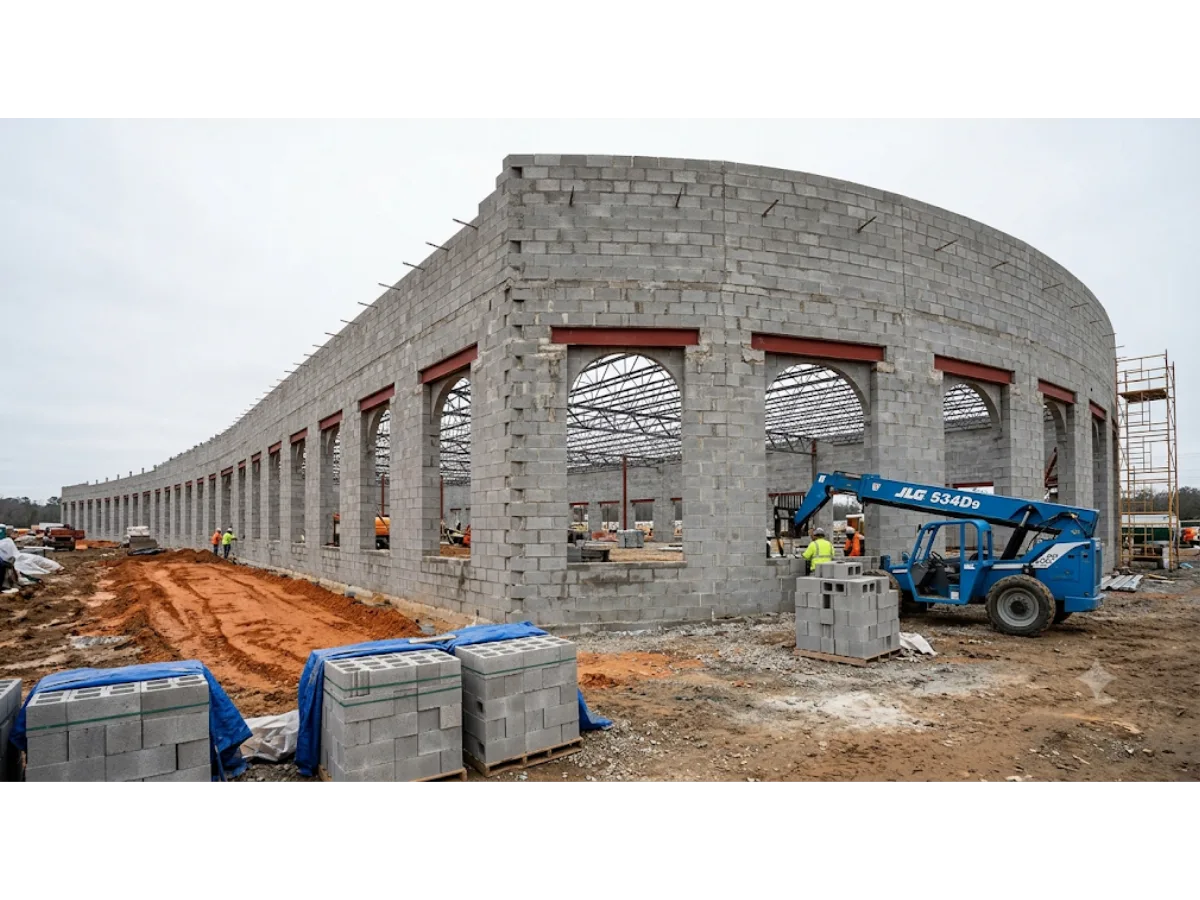
Jacksonville Concrete Block Walls
Reinforced Concrete Block Walls Built for Jacksonville Wind, Water, and Soil
A concrete block wall is only as good as what is inside it. Stacked dry, block is just a fence you can push over. Filled with grout and tied together with rebar, the same block becomes a single engineered wall that shrugs off hurricane wind, stands up to standing water, and outlasts anything wood-framed in Northeast Florida’s climate. First Coast Concrete builds concrete block walls the way Florida ground and Florida weather demand: proper footings, the right reinforcement schedule, and clean workmanship from the first course to the cap.
Concrete Block Wall Contractors in Jacksonville
We build block walls for homeowners, builders, and property owners across Duval County and into Clay, St. Johns, and Nassau. Some clients want a privacy wall along a property line. Others need a screen wall to hide a pool pump or trash enclosure, a stem wall for a raised structure, or a block foundation wall for a new build or addition. Whatever the wall does, the fundamentals are the same, and we get them right.
Concrete block, or CMU, is the gray Concrete Masonry Unit you have seen on nearly every job site in Florida. The standard unit is a hollow 8 by 8 by 16 inch block, and the hollow cores are the point. Vertical rebar runs through them, horizontal bond beams tie the wall together at set courses, and grout fills the reinforced cells so the finished wall behaves as one continuous structure rather than a loose stack. That is what makes block the workhorse material it is here.
First Coast Concrete is licensed and insured for block work. We pull the Duval County permit, coordinate with a structural engineer when the wall calls for one, and schedule the required inspections through to completion.
Concrete Block Walls We Build
We handle the full range of residential and general block wall work across the Jacksonville area:
Privacy Walls. Solid block walls along property lines for privacy, noise reduction, and a finished look that a wood fence cannot match for longevity. Built on a proper footing with vertical rebar and bond beams sized to wall height, then capped and finished or stuccoed to suit the property.
Screen and Enclosure Walls. Freestanding walls that screen pool equipment, HVAC condensers, generators, and dumpster or trash enclosures. Lower in height than a privacy wall but built to the same standard so they stay plumb and crack-free.
Stem Walls. For raised slab-on-grade construction, the block stem wall forms the perimeter foundation up to finished floor elevation. Cores are reinforced and filled, and plumbing and utility penetrations are blocked out before grout. This is a common system across Northeast Florida, and it overlaps with our foundation work. For full new-build and replacement foundation systems, see our concrete foundations page.
Block Foundation Walls. Perimeter and below-grade block walls for new structures, garages, and additions, waterproofed on the exterior before backfill so the wall stays dry through a Florida rainy season.
Garden and Low Site Walls. Short freestanding block walls for landscaping, raised beds, and grade separation. Where a wall has to hold back a meaningful slope or soil load, that becomes a retaining wall with its own engineering. We keep those distinct and detail them on our retaining walls page.
Why Concrete Block Suits Florida
Block earns its place here for reasons that have nothing to do with looks:
Wind resistance. Jacksonville’s residential design wind speed is roughly 130 mph for most construction. A properly reinforced CMU wall, with rebar and grouted cells sized to that wind load, resists lateral force in a way a stacked or under-reinforced wall never will. The reinforcement is not optional detailing. It is the difference between a wall that performs in a storm and one that fails.
Moisture and flood tolerance. Many Jacksonville lots sit in FEMA flood zones along the St. Johns basin and the coast. Block tolerates wetting and standing water far better than wood framing, and breakaway-wall provisions that apply to framed construction do not apply to masonry. That makes block the practical choice on low-lying and flood-prone sites.
Fire and durability. CMU carries an inherent fire rating and does not rot, warp, or feed termites. Detailed and waterproofed correctly, a block wall is close to a lifetime structure.
One caution: block is not waterproof on its own. Mortar joints, the top of the wall, and any below-grade face all need proper detailing to keep water out. We design drainage and waterproofing into the wall from the start rather than chasing leaks later.
How We Build a Block Wall
Every wall we build follows the same disciplined sequence:
- Site review and layout. We walk the site, confirm the wall line and height, check for setbacks and easements, and confirm whether the wall needs an engineer’s design.
- Footing. A reinforced concrete footing is poured to the right width and depth for the wall and the soil. Jacksonville’s sandy fill sometimes calls for a wider footing than inland markets use. The footing is the foundation of the whole wall, and we do not rush it.
- First course and layout lines. The first course is snapped, squared, and corner-led. A misaligned first course multiplies error all the way up, so we get it right before we go higher.
- Reinforcement and grout. Vertical rebar is set at the spacing called out by the design, commonly 16, 24, or 32 inches on center depending on height and wind exposure. Horizontal bond beams go in at specified courses, and the reinforced cells are filled with grout in consolidated lifts per ACI 530.
- Inspections. We coordinate the required inspections with Duval County, including any pre-grout inspection, so cells are never filled ahead of sign-off.
- Cap, waterproofing, and finish. The wall is capped, waterproofed where needed, and finished with stucco, paint, or the look you want.
What a Block Wall Costs
There is no honest flat per-foot price for a block wall, and we will not pretend otherwise. Cost is driven by height, length, the rebar and grout schedule, footing requirements, site access, and finish. A four-foot privacy wall on an open lot is a different project from a tall reinforced wall on a tight, sloped, or flood-zone site. What we can promise is a written, itemized quote scoped to your actual wall, with the specifications spelled out, so you can compare bids on equal terms instead of guessing what is buried in a low number.
Why Jacksonville Property Owners Choose First Coast Concrete
Licensed, insured, and permitted. We pull the permit, coordinate with the building department, and schedule every required inspection. We carry general liability and workers’ compensation coverage.
Built for Florida ground. We have built walls across Duval County, from sandy Westside fill to tighter Southside soils. We know where footings need to be wider, where the water table runs shallow, and how to detail a wall so it stays plumb and dry.
Free written estimates. No phone quotes and no napkin math. We walk the site, review any plans, and hand you a detailed written scope before you commit to anything.
Service Area
First Coast Concrete builds concrete block walls throughout Jacksonville and the surrounding First Coast:
We are licensed for block work throughout Duval, Clay, St. Johns, Nassau, and Baker counties.
Running a commercial or structural project? Our commercial CMU and block wall page covers load-bearing, shear, and fire-rated CMU built for general contractors, developers, and property managers.
Frequently Asked Questions - Concrete Block Wall Contractors Jacksonville FL
Do I need a permit to build a concrete block wall in Jacksonville? For most freestanding block walls, yes, and almost always for any structural wall. Short garden or planter walls under a defined height are sometimes exempt, but the threshold depends on the wall height and location. We confirm the requirement with Duval County and pull the permit as part of our scope so nothing stalls mid-project.
Why is concrete block so common for walls in Florida? Reinforced CMU resists hurricane wind loads, tolerates moisture and flooding far better than wood framing, and carries a built-in fire rating. When the cells are filled with grout and tied together with rebar, a stack of block becomes a single engineered wall. Those properties make it the default wall material across the state.
How much does a concrete block wall cost in Jacksonville? Cost depends on height, length, the reinforcement and grout schedule, footing requirements, and the finish. A short residential privacy wall prices very differently from a tall reinforced wall on a difficult site. We quote from the actual wall rather than a flat per-foot rate, and the quote is written and itemized.
How long does it take to build a block wall? A typical residential privacy or screen wall runs a few working days once the footing has cured and materials are on site. Permit review and inspection scheduling can add time at the front of the project. We give you a realistic timeline after we see the site.
Do you build both residential and commercial block walls? Yes. We build residential and general block walls along with structural commercial CMU. For load-bearing, shear, and fire-rated walls on commercial projects, see our commercial CMU page.