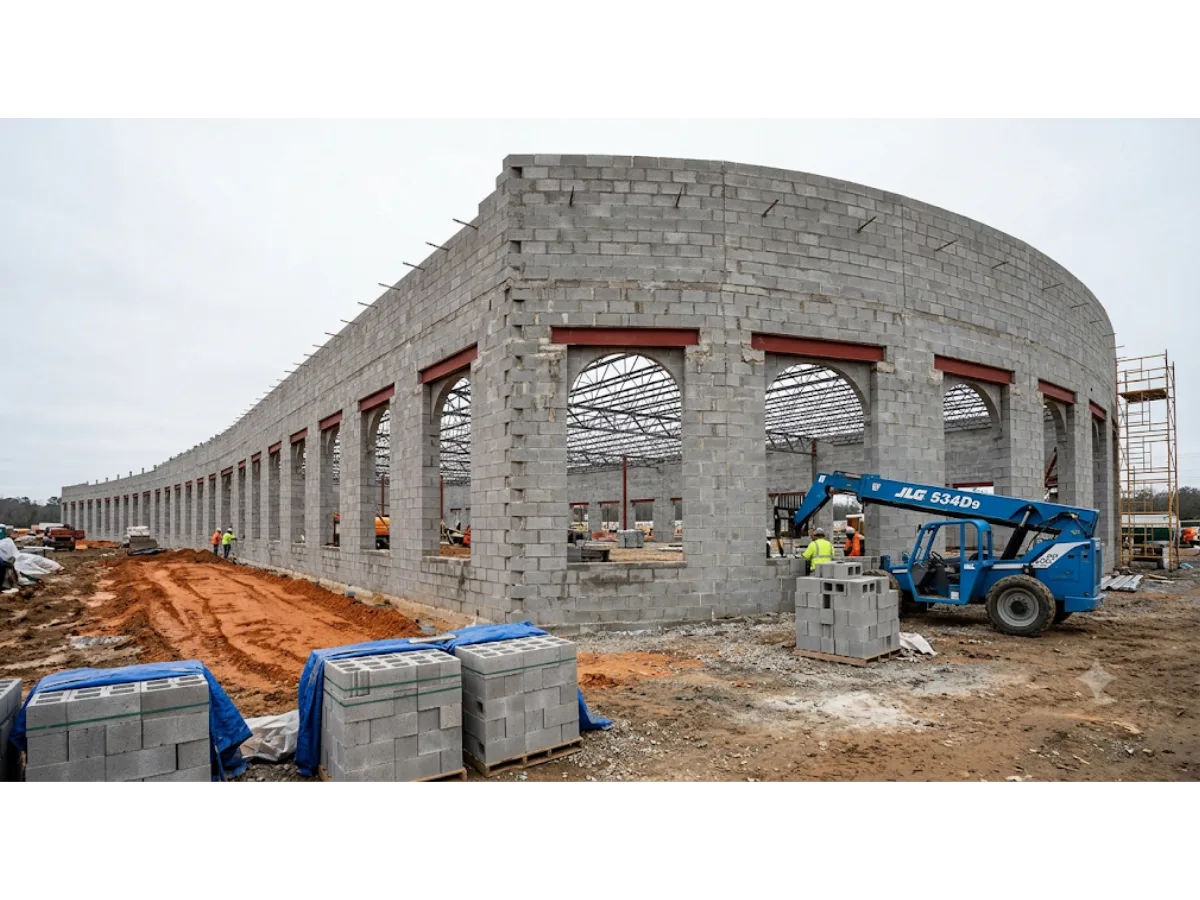
Commercial CMU Contractors Jacksonville
Structural CMU for General Contractors, Developers, and Property Managers Across the First Coast
On a commercial job, concrete block is not a finish choice. It is the engineer’s structural system, and the value is entirely in the details a residential mason often skips: correct rebar placement, bond beams at the specified courses, grout lifts consolidated to spec, and an inspection sequence that has to happen in the right order before a single cell is filled. First Coast Concrete builds commercial CMU to the structural drawings, coordinates the inspections with Duval County, and keeps the masonry phase off your critical path. When a block sub misses a pre-grout inspection, every trade behind them waits. We do not let that happen.
Commercial CMU Contractors in Jacksonville
We build structural and non-structural CMU for general contractors, commercial developers, property managers, and institutional clients across the Jacksonville metro. Our commercial clients include GCs who need a reliable block sub on a tight schedule, developers building multi-tenant and light-industrial shells, and owners expanding warehouse and retail footprints. We work as a masonry subcontractor and as a prime on smaller commercial scopes.
CMU, the Concrete Masonry Unit, is specified on nearly every commercial project in Florida because reinforced block delivers wind resistance, lateral capacity, fire separation, and flood tolerance that other systems need added assemblies to match. We build it the way the structural engineer drew it, not the way it is fastest to stack.
This page is for commercial buyers. For residential and general block walls, privacy walls, and stem walls, see our concrete block walls page.
Commercial CMU We Build
Our commercial crew handles the full range of structural and non-structural block:
Load-Bearing CMU Walls. Masonry walls that carry floor and roof loads, used as a tilt-wall alternative and in buildings where the block itself is the structure. Built from the engineer’s drawings with the inspection phases coordinated through Duval County.
Shear Walls. Lateral load-resisting walls for commercial and industrial buildings. These live or die on rebar placement and grout-fill schedule, and both are inspected during construction rather than after the fact.
Fire-Rated and Separation Walls. CMU carries an inherent fire rating that framed assemblies have to build up to. We construct fire and party walls in multi-tenant buildings, warehouses, and self-storage facilities to the required rating.
Commercial Foundation and Stem Walls. Below-grade perimeter and stem walls for commercial structures, waterproofed before backfill. For poured foundation systems, we coordinate with our concrete foundations scope so the structural transition is clean.
Warehouse and Tilt-Slab Infill. CMU infill panels in steel-framed and tilt-up industrial buildings to close openings, build office partitions, or extend the envelope.
Screen, Perimeter, and Equipment-Yard Walls. Freestanding commercial block walls for security, dumpster enclosures, and mechanical screening, built with footings, vertical rebar, and bond beams per code.
For poured commercial flatwork, parking lots, dock aprons, and equipment slabs, see our commercial concrete page.
Built to Coordinate With Your Project Team
Commercial block work succeeds or fails on coordination. Here is how we work with GCs and owners:
- Bid from plans. Send the architectural and structural drawings and we return an itemized, written bid for the CMU scope. No square-foot guesses.
- Submittals and documentation. Product data, mix and grout submittals, and certificates of insurance handled before mobilization.
- Certificates of insurance. General liability and workers’ compensation coverage, with the GC or owner named as additional insured where the contract requires it.
- Schedule coordination. We stage block and grout deliveries and crew the work to your timeline so masonry stays off the critical path.
- Inspection ownership. We own the inspection milestones so cells are never filled ahead of sign-off.
The Inspection Sequence
The inspection order is what separates a smooth masonry phase from a stalled one:
- Footing inspection. Footing dimensions, dowel placement, and grade confirmed before the first course goes down.
- Reinforcement inspection. Vertical rebar, bond beam steel, and lap splices verified against the structural drawings.
- Pre-grout inspection. The mandatory checkpoint on most commercial work. Cells stay open until the reinforcement is inspected and signed off. Only then do we fill.
- In-progress and final. Remaining milestones coordinated through closeout.
Skipping or rushing the pre-grout inspection is the single most common way a block sub blows a schedule and triggers a tear-out. We plan the pour around the inspection, not the other way around.
Florida Building Code and Commercial Masonry
Wind loading. Jacksonville’s design wind speeds drive wall thickness, rebar spacing, and grout-fill requirements. Commercial construction is engineered to its risk category, and we build to those reinforcement schedules exactly as drawn, commonly 16, 24, or 32 inches on center depending on wall height and exposure.
Code chapters. We build to Florida Building Code Chapter 19 (Concrete) and Chapter 21 (Masonry), and to ACI 530, Building Code Requirements for Masonry Structures, on all relevant commercial work.
Flood zones. Many Jacksonville commercial sites sit in FEMA flood zones along the St. Johns River basin and the coast. CMU offers far better flood resistance than framed construction, and breakaway-wall provisions do not apply to masonry, which matters on flood-zone commercial projects.
Why General Contractors Choose First Coast Concrete
We read structural plans. We build from the engineered drawings and coordinate with the structural engineer of record, not from a generic wall standard.
Inspection-first. We own the inspection sequence so the project never stalls on a missed pre-grout sign-off.
Documentation handled. Certificates of insurance and submittals turned around promptly for GCs, owners, and property managers.
Locally accountable. A Jacksonville company that knows Duval County’s commercial review and inspection process and the soil conditions across the First Coast.
How to Get a Bid
- Send your plans. Email the architectural and structural drawings to start. For projects without drawings yet, we will walk the site and scope the work with you.
- Scope and bid. We return an itemized, written bid for the CMU scope: reinforcement schedule, grout fill, finish, exclusions, and timeline.
- Submittals and CoI. Once awarded, we turn around submittals and certificates of insurance before mobilization.
- Build and inspect. We coordinate with your project team on schedule and own the inspection milestones through closeout.
For competitive bids, we can provide bid and performance bonds when required.
Service Area
First Coast Concrete provides commercial CMU construction throughout Jacksonville and the broader First Coast:
We are licensed for commercial masonry work throughout Duval, Clay, St. Johns, Nassau, and Baker counties.
For residential and general block walls, see our concrete block walls page.
Frequently Asked Questions - Commercial CMU Contractors Jacksonville
Can you work as a CMU subcontractor on our GC schedule in Jacksonville? Yes. We work as a CMU subcontractor under general contractors throughout Duval County and the First Coast. We attend pre-construction meetings, return submittals and certificates of insurance before mobilization, stage block deliveries to your schedule, and keep the masonry phase off your critical path.
What codes do you build commercial CMU walls to? We build from the structural engineer’s drawings to Florida Building Code Chapter 19 (Concrete) and Chapter 21 (Masonry), and to ACI 530. Rebar spacing, bond beam courses, and grout-fill schedules follow the project’s wind-load design rather than a generic standard. Jacksonville’s design wind speeds set those reinforcement details.
Do you provide certificates of insurance and bid from plans? Yes. We carry general liability and workers’ compensation coverage and issue certificates of insurance promptly, naming the GC or owner as additional insured where required, before we mobilize. Send the architectural and structural drawings and we bid the CMU scope from them.
How do you handle inspections on commercial CMU work? The pre-grout inspection is the one that stops a job. Cells cannot be filled until the reinforcement is inspected and signed off. We coordinate the footing, reinforcement, and pre-grout inspection milestones with Duval County so the pour is never held up and nothing has to be torn out.
How do I get a commercial CMU bid? Send us the architectural and structural drawings and we return an itemized, written bid for the CMU scope. Pricing follows the reinforcement and grout schedule, wall height, and finish, not a flat per-foot rate. For projects without drawings yet, we will walk the site and scope it with you first.